Kick and bass phase alignment matters when both signals produce overlapping low frequencies at the same moment. It does not mean every waveform peak must line up on a screen, and it is not a substitute for sound choice, envelopes, level balance or arrangement.
Phase, Polarity and Timing Are Different
These terms are often used as if they describe one control. They do not.
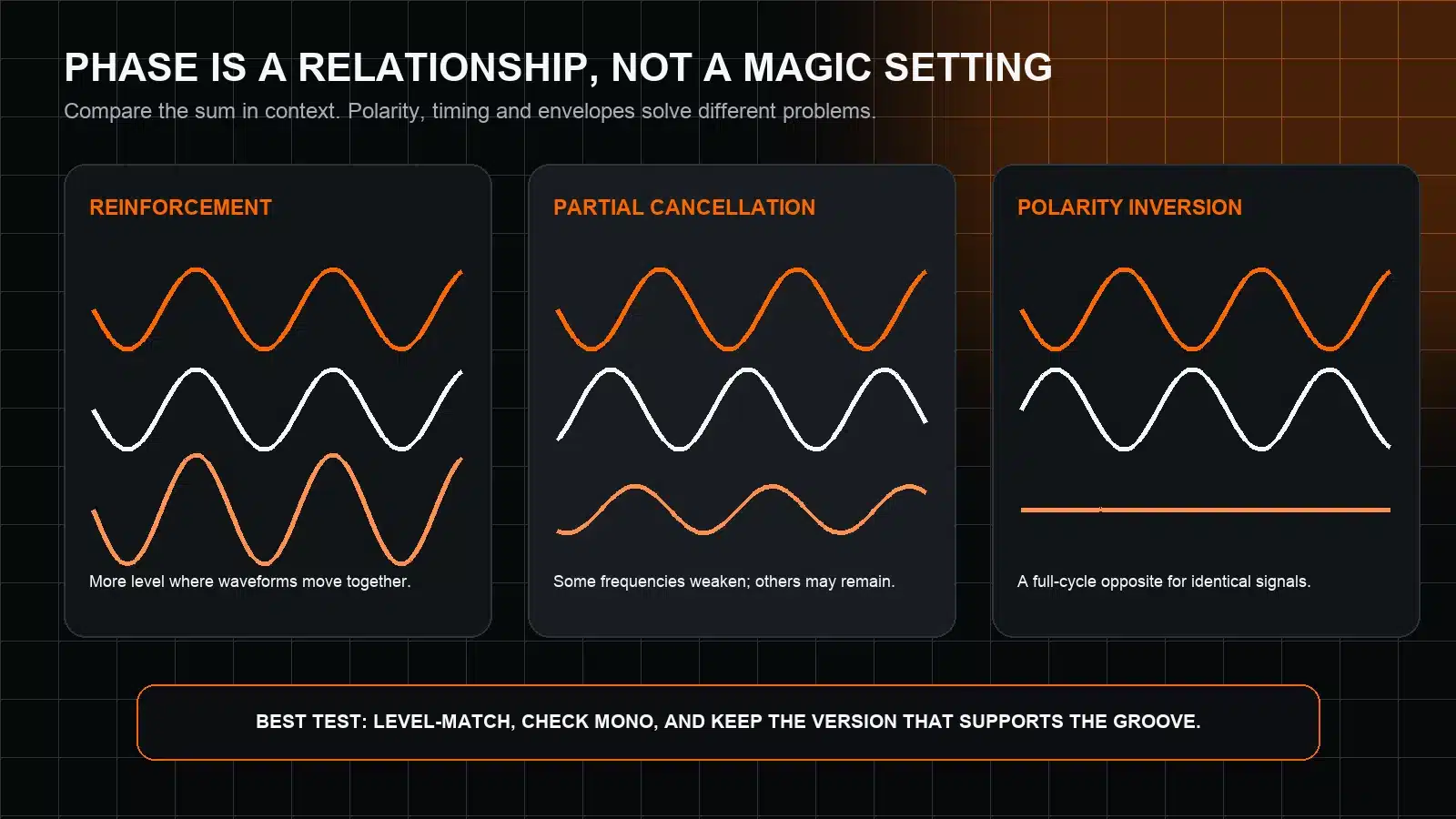
Two identical sine waves at the same level reinforce when aligned and cancel when one is inverted. Real kicks and basses are more complex: their frequency content, pitch and amplitude change over time. A small shift may improve one band while weakening another.
When Kick and Bass Phase Alignment Matters Most
The effect is easiest to hear when the kick has a sustained low-frequency tail and the bass begins during that tail. Repeatable synthetic sources make the relationship relatively stable, so changing polarity, sample start or timing may produce a consistent improvement.
It is less predictable when the bass oscillator starts at a random phase, the bass moves through several notes, or either sound contains strong modulation. In those cases, a setting that looks perfect on one hit may behave differently on the next. The goal becomes consistency across the musical phrase.
| Situation | How useful is alignment? | What to prioritise |
|---|---|---|
| Long tonal kick + sustained sub | Often important | Tune envelopes, polarity and start relationship |
| Short kick + bass starts later | Usually less critical | Level, groove and clean handoff |
| Free-running bass oscillator | Static alignment may not repeat | Consistency across many notes and stable low-end design |
| Live or acoustic bass | Waveform varies continuously | Arrangement, editing, dynamics and broad spectral balance |
The Audible Symptoms of a Poor Relationship
Do not diagnose phase from appearance alone. Listen for a low end that changes strength from hit to hit, loses weight in mono, produces a hollow first cycle or seems loud individually but smaller when kick and bass play together. A spectrum analyser or oscilloscope can help locate the moment, but the musical symptom should lead the investigation.
Also rule out simpler causes. The bass may be too loud. The kick tail may be longer than the groove allows. A limiter may react to their combined peak and make the result feel smaller. Both sounds may be strong in the same octave even when their waveform relationship is reasonable.
A Reliable Kick and Bass Phase-Check Workflow
- Loop a representative phrase. Include several bass notes and the actual processing used in the section—not one isolated hit.
- Listen in mono. Lower the monitoring level and focus on stability, attack and perceived weight.
- Bypass the master limiter temporarily. Prevent loudness control from hiding changes in the source relationship.
- Compare polarity on one source. Do not assume the inverted state is wrong; choose by the combined result.
- Try small start or timing changes. Move the kick sample start, the bass note or the synth phase behaviour when the source allows it.
- Check every important bass note. A setting that helps the root may weaken a higher note.
- Level-match and restore context. Confirm the choice with drums, synths and vocals playing.
Method 1: Compare Polarity
Most DAWs provide a polarity invert control in a utility or channel tool. Toggle it on the kick or bass while both play. One position may give a firmer fundamental, clearer transient or more even sequence.
Polarity inversion is a full-wave flip, not a frequency-specific phase rotation. It can be an excellent quick comparison, but it does not guarantee improvement when the sources differ in pitch or change over time.
Method 2: Adjust Sample Start or Note Timing
Moving a kick sample by a small amount changes its timing relationship with the bass at every frequency. Trimming silence or shifting the sample start can also change which cycle leads the transient. Make small moves and recheck the groove; a technically stronger low end is not useful if the kick now feels late.
If you move the bass note, protect the rhythmic intention. Sometimes the cleanest solution is not micro-alignment but a deliberate handoff: shorten the kick tail, delay the bass until after the transient or use a rest.
Method 3: Control Envelope Overlap
Envelope editing is often more robust than chasing a perfect phase snapshot. Shorten the kick’s low tail, reduce the bass attack, or shape the bass release so the sources do not sustain at full level together.
This is particularly effective when the bass changes notes. Each pitch has a different cycle length, so one time offset cannot produce the same phase relationship across the sequence. Reducing overlap makes those changing relationships less dominant.
Method 4: Use Sidechain as a Musical Envelope
Sidechain compression or volume shaping can create a repeatable space for the kick. Set the release by listening to the groove rather than matching a visual curve. Too-short recovery can cause distortion or a low-frequency ripple; too-long recovery may remove the bass’s momentum.
Ducking reduces simultaneous energy, which lowers the importance of exact phase during the kick. It does not “fix phase” in a literal sense. It changes the overlap so cancellation and reinforcement are less exposed.
What an Oscilloscope Can—and Cannot—Tell You
An oscilloscope can show whether the low-frequency portions move together at a chosen moment. It is useful for repeatable electronic sources, sample-start checks and confirming that a polarity control works as expected.
It cannot decide which version grooves better, translate every frequency relationship into one visual answer or guarantee consistency across different bass notes. Zoom out and inspect several hits. Then close the display and make the final choice by ear at matched level.
Common Phase-Alignment Mistakes
Aligning only the first visible peak
The first peak may be the click or upper-frequency attack rather than the low-frequency cycle that controls weight. Inspect the relevant overlap and listen to the full sum.
Moving the kick until the groove changes
A few milliseconds can affect feel. If the low end improves but the kick loses urgency, adjust sample start or envelope instead of shifting the event.
Ignoring changing bass notes
A root note and a fifth have different cycle lengths. Test the complete phrase, especially notes that coincide with long kick tails.
Using correlation meters as pass/fail indicators
Correlation is useful for stereo relationships, but kick-versus-bass interaction is a time- and frequency-dependent mono problem. It cannot replace listening, polarity comparison and envelope decisions.
Fixing phase before sound selection
If the kick and bass both occupy the same octave with long tails, a different kick or shorter bass patch may solve the mix faster and more reliably. Choose complementary sources before applying increasingly complex corrections.
A Better Decision Order
- Choose complementary kick and bass sounds.
- Write a rhythm that creates space.
- Set note lengths and envelopes.
- Balance levels in mono.
- Compare polarity and small timing changes.
- Add ducking only as much as the groove needs.
- Verify the full phrase and the full mix.
If the rest of the low end is crowded, revisit EMP’s guide to layering synths without mud and the broader electronic music mixing checklist. Phase alignment is one diagnostic step, not a complete low-end strategy.
Final Checklist
- Did you test a representative musical phrase rather than one hit?
- Did you compare in mono at matched level?
- Is the issue phase, polarity, timing or excessive overlap?
- Does the chosen setting work across different bass notes?
- Did you preserve the groove while changing timing?
- Would sound selection or envelope editing be more reliable?
- Does the full mix benefit—not only the isolated low end?
The best kick and bass relationship is the one that repeats consistently, preserves the groove and leaves useful headroom. Use the display to understand the problem; use the mix to choose the answer.
Sources: Sound On Sound: Phase Demystified; Sound On Sound: Mixing Bass; Ableton Live Manual: Utility and audio effects. DAW control names vary, but the acoustic relationships described here are application-independent.