A melodic techno arrangement should feel like one idea changing meaning over time. The solution is not to add a new layer every eight bars. It is to control when the listener receives rhythm, harmony, tension, scale and release.
Why Good Loops Become Flat Arrangements
An eight-bar loop can contain the track’s best drums, bass, chord movement and hook, yet reveal everything at once. Copying it across the timeline preserves sound but removes narrative. The listener has no unanswered question, no meaningful contrast and no reason to experience the next section differently.
Arrangement starts by deciding what to withhold. A powerful lead is more effective when its rhythm, harmony or full frequency range has been implied earlier. A breakdown feels larger when the preceding groove established weight. A second drop earns its place when it resolves something the first drop left open.
Start With an Energy Map, Not a Bar Count
Before arranging details, draw a simple curve from low to high energy. Mark the main arrival points, the deepest reduction and the final release. Then assign musical mechanisms to each change: drums enter, bass disappears, harmony widens, the motif moves registers, reverb expands or the kick returns.
Bars are containers, not rules. Sixteen- and thirty-two-bar sections are common because they are easy to phrase and mix, but the musical event should determine whether a section is finished. If the listener has understood the idea after eight bars, use a variation or move forward.
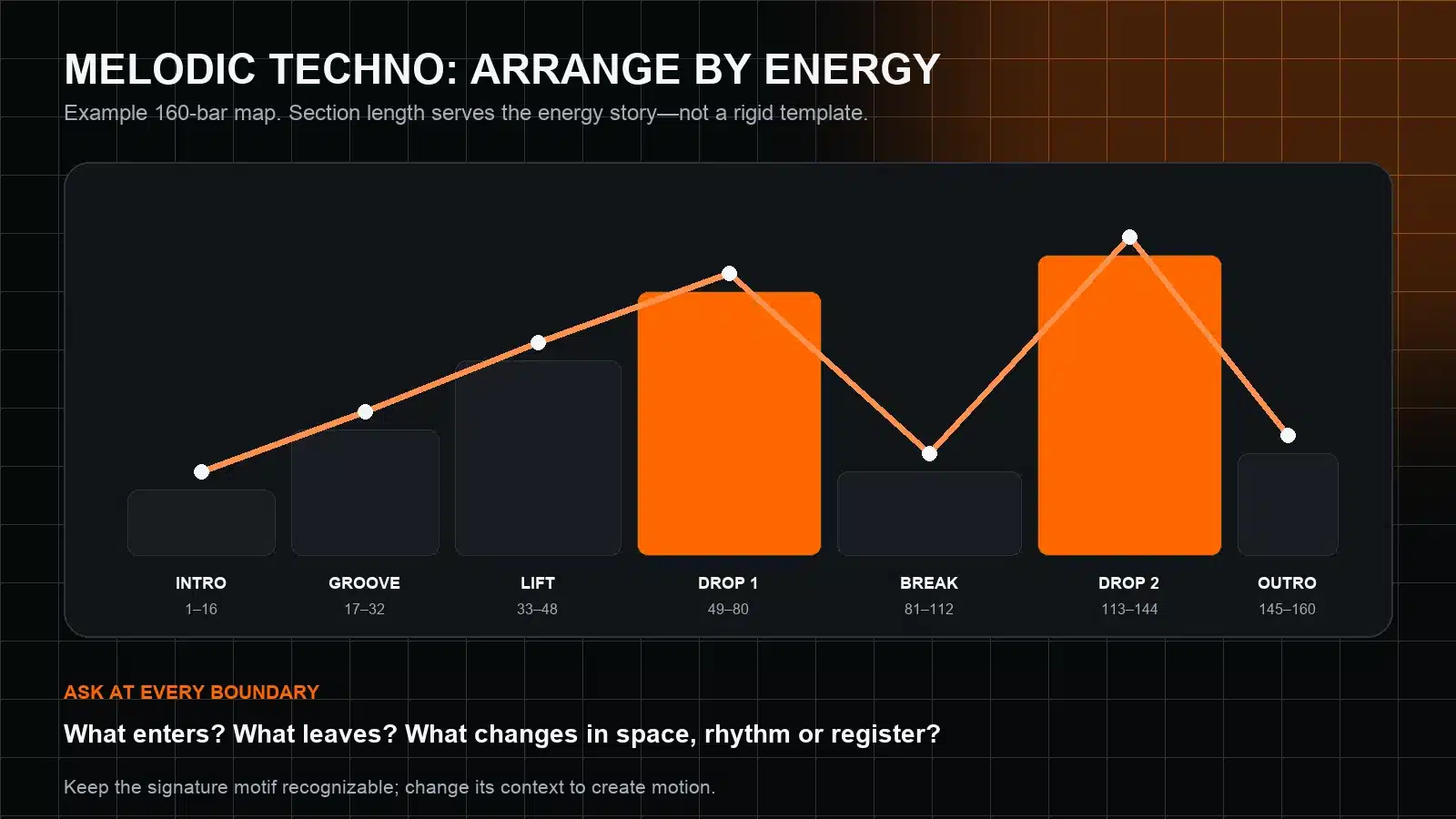
A Practical Melodic Techno Arrangement
Intro: make the grid readable
Begin with enough rhythmic information for a DJ or listener to understand the pulse. A kick, restrained top loop, atmosphere and one tonal clue may be sufficient. Avoid presenting the full bassline, complete motif and brightest percussion immediately. The intro should promise the track without summarising it.
Groove: establish the physical identity
Introduce the bass and the percussion elements that define movement. Keep the melodic information partial: a filtered chord, a single note from the motif or a texture that shares its rhythm. The listener should recognise the track’s world before hearing its full statement.
Lift: increase expectation without delivering everything
Add motion through automation, a higher register, a shorter repeating motif or a reduction in low-end certainty. Tension does not require constant risers. A missing kick, a delayed resolution or a gradually widening harmonic layer can create a stronger directional pull.
First drop: prove the central idea
The first drop should answer the introduction’s promise. Return the low-end anchor and reveal the motif in a form that reads clearly over the groove. Protect hierarchy: if the lead is the event, simplify competing percussion or chord layers rather than turning everything up.
Breakdown: change the listening scale
A breakdown is not simply the drop without drums. Change the sense of space and time. Let harmony sustain, move the motif into a new register, expose an atmospheric counter-line or leave a deliberate silence. Remove low-frequency certainty so the next return has physical meaning.
Second drop: evolve one important dimension
The second drop needs a reason to exist, but it does not need a new song. Change one high-impact dimension: extend the motif, add a counter-rhythm, alter the bass response, widen the harmony or strengthen the final cadence. Preserve enough of the first drop that the return feels earned.
Outro: release without collapsing
Remove melodic and harmonic layers in a useful order while keeping the grid stable. An outro that preserves kick, percussion and a restrained bass element can remain mix-friendly without feeling like an abrupt technical appendix.
Use Four Types of Contrast
| Contrast | Low-energy state | High-energy state |
|---|---|---|
| Density | Few active roles and more silence | More rhythmic interaction, not necessarily more tracks |
| Register | Midrange focus or filtered highs | Expanded upper register and restored sub weight |
| Space | Longer tails and distant placement | Drier, closer transients with controlled ambience |
| Rhythm | Implied pulse or suspended groove | Clear kick, bass and subdivision accents |
These dimensions can move in opposite directions. A breakdown may become harmonically richer while losing rhythmic density. A drop may feel larger because it becomes drier and more direct, not because it gains reverb.
Build Transitions From Cause and Effect
A transition works when the outgoing section creates a need that the incoming section satisfies. Remove the kick, narrow the spectrum or hold an unresolved note; then let the next section restore weight, width or harmony. This cause-and-effect relationship matters more than stacking several generic effects.
Use subtraction before decoration
Mute the final bass note, remove the clap for half a bar or shorten the loop before adding sweeps and impacts. Subtraction creates a hole that the next downbeat can fill. Decorative effects are more convincing when they describe a structural change that already exists.
Prepare the new section early
Introduce one element from the destination before the boundary: a reversed fragment of the motif, a filtered percussion layer or the reverb tail of the first chord. The ear receives a clue, then recognises its meaning after the transition.
Keep the Motif Alive Without Overwriting It
Write one complete motif, then derive smaller versions. The intro may use only its rhythm. The groove section may reveal two notes. The breakdown may stretch the harmony beneath it. The second drop may add a response in another register.
This creates continuity without repetition. If you are developing several synth layers around the motif, use a role-based hierarchy so each layer contributes weight, body, attack or air. EMP’s guide to clean synth layering covers that decision in detail.

Study complete section relationships
Melodic Techno Bundle
The EMP Melodic Techno Bundle currently includes ten construction kits alongside MIDI, loops, samples and preset libraries. Use the kits as arrangement references: map when roles enter, how breakdowns reduce density and what changes between drops. Then rebuild the energy story with your own motif instead of copying a finished sequence.
A Fast Arrangement Pass That Prevents Overproduction
- Duplicate the core loop across a rough full-length timeline.
- Place section markers and write one sentence describing each section’s job.
- Delete parts until the energy curve is audible with no transition effects.
- Create three motif states: implied, partial and complete.
- Change one contrast dimension at every major boundary.
- Add transitions only after the sections cause and resolve tension.
- Listen from start to finish without editing; mark where attention drops.
Final Arrangement Checklist
- Can every section’s job be explained in one sentence?
- Does the intro promise the track without revealing the full payoff?
- Is the first drop clear rather than merely dense?
- Does the breakdown change space, scale or harmony—not only remove drums?
- Does the second drop evolve one meaningful dimension?
- Do transitions begin with structural cause and effect?
- Does the signature motif remain recognisable in different contexts?
For broader sound-design, groove and mix context, see EMP’s melodic techno production tips. This guide stays focused on the arrangement problem: turning one strong loop into a changing energy story.
Sources: Ableton Live Manual: Arrangement View; Dennis DeSantis, Making Music; Native Instruments: melodic techno production guide. The example bar map is illustrative rather than prescriptive.